





Synopsis: The Evolution of Sales
This narrative depicts the scientific management of uncertainty in business negotiations through the lens of Exa, an Intelligent Inference Engine. The protagonist, a seasoned Head of Sales, transcends the traditional reliance on gut instinct to analyze win rates in real-time, empowered by a system built on Bayesian inference algorithms.
By mathematically quantifying diverse variables—from the silent risks of client inaction to aggressive competitor maneuvers—the engine facilitates cool-headed, rational decision-making, untainted by emotion. Ultimately, these data-driven probabilistic insights replace vague optimism with a precise navigational chart, guiding the protagonist through crises toward success.
In essence, this story underscores a paradigm shift in the modern business landscape: sales is no longer a mere gamble, but an evolution into rigorous data science.
Battlefield in the Fog
The winter afternoon sun slanted through the large glass window of the conference room. Its light was so transparent it revealed every speck of dust, yet the future of the company, as seen through the eyes of the Head of Sales, was quite the opposite. The ‘Energy Project’ he was in charge of was enormous, but it felt like an elusive mirage.
“Head of Sales, let’s be frank.”
The CEO took off his glasses and rubbed his forehead. His voice was weary but still sharp. “Is this deal really coming through? You know how much resource we’ve poured into it.”
He offered a familiar smile, a defense mechanism honed over 20 years in sales. “The mood is good, CEO. Customer feedback isn’t bad either. My gut feeling is… about 80%.”
80%
The moment he uttered those words, he felt a bitter taste on his tongue. It wasn’t a lie, but it wasn’t the truth either. It was the safest number sales professionals used to hide their anxiety. Too incompetent at 50, too accountable at 100 – a last resort for plausible deniability.
Back at his desk, he lowered the blinds. In the dim room, the tablet screen on his desk was the only light source. The ‘Intelligent Inference Engine’ he had secretly introduced recently blinked quietly.
He was afraid to touch the screen, fearing his 80% incantation would break. But as his finger made contact, the system spat out emotionless text.
[Status Update] Current Confidence in Order Intake: 26.4%
He wiped his face. 26.4%. That number, calculated to one decimal place, shattered his optimism. It wasn’t an accusation. It merely pointed to the location of a cliff hidden in the fog, which he had deliberately tried to ignore.
The Reconnaissance Phase
In the client’s conference room, a taut tension hung in the air. There was no champagne like at a hotel banquet. Instead, there was stale coffee, thick proposals, and the sharp eyes of evaluators scrutinizing them.
The first proposal presentation. The Head of Sales sharpened his 20 years of sales intuition. After the presentation, the technical team leader posed a question.
“I understand the specs, but is 100% integration with our existing legacy system guaranteed?”
“Absolutely. Please refer to page 12 of our reference document.”
The technical team leader nodded. Not a bad start. In the car returning to the office, the Head of Sales opened his tablet and entered the first data point.
[Input: S1 (Exploration) / Weak Positive (+1.0)]
Content: Technical contact’s favorable response, specific integration inquiry.
As the initial data was entered, the system delivered its first probability.
[Confidence in Order Intake: 33.7%]
The Poison Named Silence
Just two weeks prior, hope had seemed tangible. The graph had risen to 33%, responding positively.
The problem came after that. Time seemed to stop. Emails were sent, but the ‘read’ receipts were met with silence.
“They’re busy. Large corporations always have slow approval processes.”
The team members comforted each other with such words. Humans have evolved to interpret waiting as ‘hope.’ They want to believe that no news is good news.
But mathematics was different. Even as he stared blankly out the window, the algorithms within the system continued to churn with merciless diligence.
[System Log: Time Decay Logic Applied]
+1 Day Silence… Beta(Risk) Increased.
With each passing day, the system rolled a virtual die. The two weeks of extended silence (Duration) were interpreted by the system as an increase in risk (β). It was like the process of iron rusting. It might look fine on the surface, but inside, the probability of success was oxidizing and crumbling.
The curve on the dashboard showed a downward trend.
‘Even at this moment, as you rest assured, your proposal is being forgotten in the client’s memory.’
The system silently screamed. The Head of Sales loosened his tie. If they remained passive, it was only a matter of time before the 80% converged to 0%.
He called his team together.
“Listen, that’s not silence. It’s a signal of ‘Delay.’”
[Warning: Confidence in Order Intake for Project ‘Energy A’ has dropped to 26.9% ▼]
He showed them the broken graph.
“See? We’re not just waiting. The probability is leaking away.”
The Head of Sales urged his team.
“Even during this period of ‘silence,’ send summary reports via email. Re-create the ROI analysis table for the budget team. If we sit still, we’re dead.”
The 27% displayed by the system spurred the complacent team into action.
The True Nature of the Crisis
Another week passed, and then the real crisis hit. Information leaked from the procurement team.
“Competitor B has entered the fray. They’re dumping prices.”
The office air froze. The project, once likely to be secured, was turning into a muddy price war.
“Head of Sales, shouldn’t we lower our price too?”
He clicked on the intelligent inference system. His fingertips trembled slightly.
[Input: S4 (Negotiation) / Weak Negative (-1.0)]
Content: Competitor’s low-price offensive confirmed.
A negative signal at the negotiation stage (Stage 4) was a critical blow. As a high weighting was applied, the system flashed a red warning light.
[Warning] Confidence in Order Intake: 19.9% (▼ Plunge)
Cause: Negative Signal & Long-term Stall Detected. Time Decay Accumulated.
The graph was cruelly trending downwards. The 33% probability had now plummeted to 19%. It wasn’t just that bad news had struck; it was also the result of the time when nothing happened, eroding the probability.
“Listen, Deputy Park. The system is sending a warning. The client isn’t reviewing; they’re forgetting us. This silence isn’t ‘under review’; it’s ‘neglect.'”
The Inflection Point
He took a gamble. Ignoring protocol, he stormed into the client’s CEO’s office. A 15-minute tea time. That was all he was allowed.
The air in the meeting room was heavy. The client’s CEO glanced at his watch, a sign of boredom. The elaborate feature descriptions he had prepared were as good as waste paper. He instinctively knew what was needed now wasn’t persuasion, but resonance.
“CEO, I didn’t come here to talk about equipment.”
He picked up a pen.
“I want to talk about fear. The fear of a factory stopping in the middle of the night.”
The CEO’s gaze stopped.
“We won’t sell machines; we’ll sell ‘365 days of uninterrupted operation.’ If it stops, we compensate for that time.”
A brief silence. The CEO leaned forward for the first time, showing interest.
“…Can you put that condition in the proposal?”
The meeting continued for another 20 minutes. In the car returning to the office, he typed a ‘Strong Positive’ signal into the system with trembling hands. The dying graph soared to 52%.
But drama wasn’t easily granted. Simultaneously, bad news arrived from the procurement team.
[Competitor B, official proposal received with a 20% price reduction. If we can’t match, we’re out.]
The team members’ faces turned pale. “20%? That’s below cost. It’s over.”
He quietly turned on his tablet again. As the new setback was reflected, the probability plunged to 43%. But he saw it. The graph didn’t break through the floor and go underground; it stubbornly held at around 40%.
The system was saying:
‘Not yet. The price took a hit, but the essence (the strong positive input) remains intact. The game isn’t over yet.’
It was courage derived from data, far more powerful than vague comfort.
The Threshold
The negotiation table was less a battlefield and more an operating room. It was cold, sharp, and one mistake could be fatal.
Facing the competitor’s low-price offensive, he played the ‘compensation liability’ card. It was a declaration that instead of cutting prices, they would bear the client’s risks.
The client’s CEO began whispering with department heads. And after a long silence, he nodded.
“Alright. Both the technical and procurement teams have evaluated it positively. We will conduct a serious internal review. Proceed.”
Verbal approval. It was a promise that could dissipate into thin air before the contract was signed. In the past, he would have cheered “We did it!” but a corner of his mind would still be plagued by anxiety.
He returned to the office and quietly entered the final data.
[Input: Verbal Approval from Final Decision Maker]
Inside the system, the Bayesian engine churned furiously. Accumulated data, periods of silence, and stage weightings collided. The raw probability, mathematically calculated, was 58.6%. Statistically, it was still a 50/50 fight.
But then, the system’s final gateway, the ‘Decision Calibration’ layer, activated. This engine knew what it meant, business-wise, to achieve a score nearing 60% at this brutal final stage (Stage 5). It was a signal that they had crossed a point of no return, beyond a simple majority.
The numbers on the screen flickered, finally converging to a single conclusion.
[Final Prediction]
Confidence in Order Intake: 88.2% (Very High)
The moment he saw that number, the Head of Sales felt a thrill run down his spine. It was different from the excitement of hitting a jackpot in gambling. It was the deep relief a captain feels when a precise radar, in a dense fog, signals “Course clear.”
He knocked on the CEO’s office door.
“CEO.”
“Yes, how did it go?”
He no longer spoke of atmosphere or gut feelings.
“The data indicates 88.2%. This number… means we’ve done it.”
That afternoon, they received the final contact from the client for contract drafting. Amidst the cheers in the office, he quietly turned off the system. The screen went dark, but he knew. Even in that darkness, the invisible hand was still awake, preparing for the next fog.
[Epilogue] The Identity of the Invisible Hand: The Exa Bayesian Engine
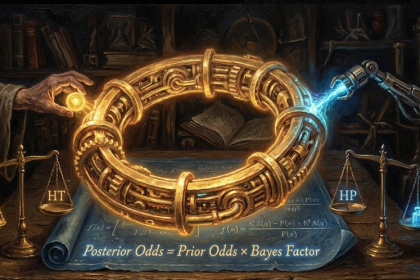
What saved the Head of Sales was not luck. It was a massive ‘Architecture of Probability,’ conceived by the mathematician Thomas Bayes 250 years ago and perfected by modern computing power.
What he fed into the system was not mere text. It was the ‘Unstructured Variables’ of the现场 atmosphere, the contact’s gaze, the competitor’s moves. The moment these uncertain pieces were entered into the system, The Exa Bayesian Engine awakened its sleepless brain.
At the heart of this system pulsates a powerful algorithm called ‘Normalized Sequential Bayesian Inference (NSBI).’
- Sequential Update: Mathematically combines past experience (Prior) with current data (Likelihood). By utilizing the ‘Conjugate Prior’ property of Beta Distribution and Binomial Distribution, it derives an error-free posterior probability immediately upon data input. In the story, it infers and sequentially updates the probability of sales success each time, providing the user with the success probability.
- Time Decay: Flowing time increases the Entropy of information. The system converts periods of silence into ‘Variance Expansion’ of the probability density function, numerically realizing the physical phenomenon where uncertainty grows over time.
- Dynamic Calibration: Transforms cold mathematical probabilities (Raw Probability) into confidence levels that humans can intuitively understand. Through Sigmoid Function and Platt Scaling techniques, it calculates non-linear decision values based on the importance of each business stage.
Humans tend to see what they want to see and believe what they want to believe. In the fog of this ‘confirmation bias,’ Exa’s Bayesian Engine, with cold rationality, constantly asks: “Is it your feeling, or is it a fact?”
The 88.2% figure the Head of Sales saw was not mere statistics. After tens of thousands of calculations, it was the safest Navigation beyond the fog that the engine had found.
Sales is no longer a gamble. With Exa’s Bayesian Engine, it becomes the most precisely designed science.
[Blog Series Proposal] Sculpting Management with Data: The Bayesian Intelligence Series
For readers intrigued by the story, this is a 4-part technical series explaining “How is such magical prediction possible?”
Post 1. [Philosophy] How to Translate Your ‘Gut Feeling’ into Mathematics
- Topic: Why Bayesian rather than Deep Learning?
- Content: The philosophical value of Bayesian inference in combining ‘prior knowledge’ and ‘on-site signals’ in business environments with limited data.
- Keywords: Explainable AI, The Power of Small Data, Quantifying Intuition.
Post 2. [Logic] Silence is Not Good News: The Magic of Time Decay and Weighting
- Topic: The precise design of sales stages and signals.
- Content: Revealing the internal logic of the NSBI model, which prevents weighting runaway through log normalization and interprets communication stalls as risk.
- Keywords: Log Weighting, Time Decay, Uncertainty Management.
Post 3. [Engineering] From Mathematical Probability to Business Confidence: Sigmoid Calibration
- Topic: Why does 58% turn into 88%?
- Content: The role of the Sigmoid (Decision Calibration) function in transforming conservative statistical figures into business-relevant confidence, and the meaning of k and Threshold parameters.
- Keywords: Impedance Matching, Confidence Calibration, Decision Threshold.
Post 4. [Expansion] Beyond Sales to SCM and Manufacturing: The Birth of the Autonomous Enterprise
- Topic: Bayesian engine applied across all areas: inventory, production, procurement.
- Content: The synergy created when TOC (Theory of Constraints) meets Bayesian. The vision of ‘Exa,’ a future-oriented ERP that self-judges and predicts.
- Keywords: Autonomous ERP, Dynamic Buffer Management, Predictive Maintenance.